You read an English article and understand almost every word. Then someone asks what you think, and you answer with the same simple vocabulary you always use.
Later, the perfect word comes to you. You knew it all along. You just couldn’t find it when you needed it.
That gap between understanding a word and being able to use it is the difference between passive and active vocabulary.
To turn passive vocabulary into active vocabulary, practice recalling words before you see them, using them in different sentences, and returning to them over time. Reading and listening still matter, but you also need opportunities to produce the language yourself.
Here is how to build that into your practice.
What is the difference between passive and active vocabulary?
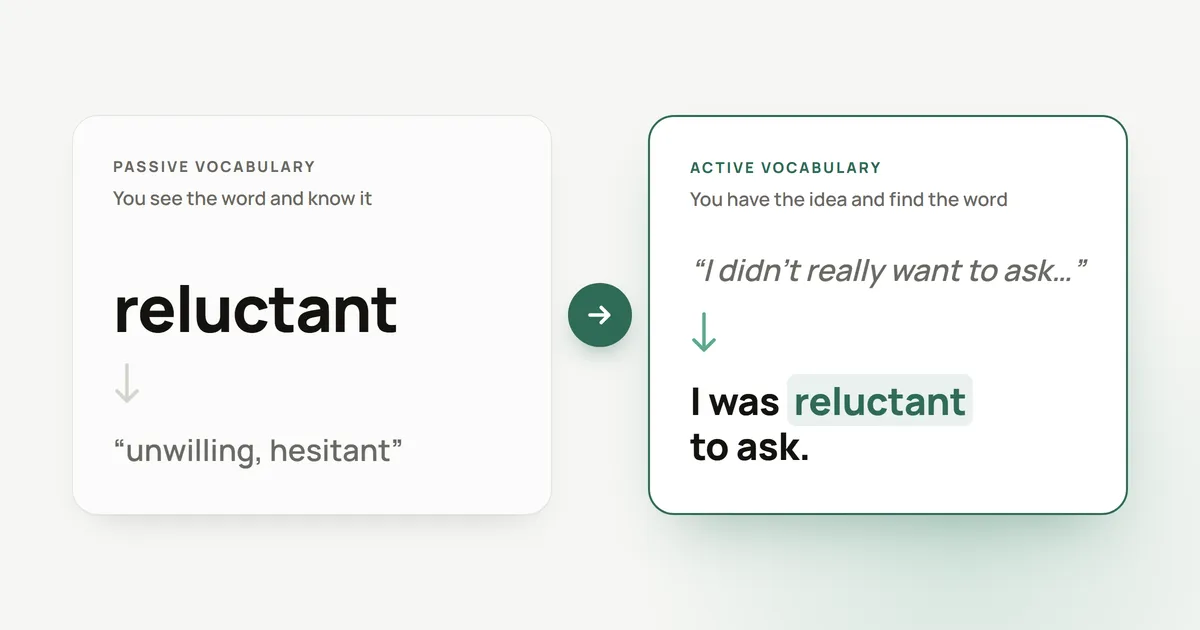
Your passive vocabulary, often called receptive vocabulary, includes words you understand when you read or hear them. Your active vocabulary, or productive vocabulary, includes words you can retrieve and use in your own speaking or writing.
Take the word reluctant.
You might understand this immediately:
- She was reluctant to ask for help.
But when describing your own experience, you say:
- I didn’t really want to ask my manager.
Both sentences communicate the idea. The question is whether reluctant was available to you as a choice.
The distinction is not a permanent label. You might use a word comfortably in an email but struggle to retrieve it during a conversation. You might know one meaning and be unfamiliar with another.
The goal is to make useful words easier to access in the situations where you need them.
Why do you recognize words but struggle to use them?
When you read, the word is already there. The surrounding sentence helps you interpret it.
When you speak or write, you work in the other direction. You have an idea and need to find the word, choose the right form, and fit it into a sentence.
Those are different demands.
If your vocabulary practice mostly involves looking at English words and recalling their translations, you are practicing an important skill. But you are spending less time practicing how to retrieve the English words yourself.
A small study by Akifumi Yanagisawa (KATE Journal, 2016) illustrates the distinction. Eighteen university students learned invented words through different practice conditions. Learners who practiced recalling the word forms performed better on a productive vocabulary test than learners in the other conditions. This was a limited experiment, not a test of conversational fluency, but it supports a useful principle: practice the kind of recall you want to improve.
Choose words you have a reason to use
Start with five words you recognize but rarely use. Choose them from situations that already matter to you: work, everyday conversations, hobbies, or something you recently wanted to explain.
For example:
- Clarify: you often need to check what someone means.
- Postpone: you talk about changing plans.
- Reliable: you describe people, products, or services.
- Overwhelmed: you explain how you feel when there is too much to do.
- Reluctant: you describe hesitation.
Ask yourself where each word could fit into something you actually say. If you cannot think of a situation, choose a more relevant word for now.
Recall the word before revealing the answer
Instead of starting every review with the English word, start with a meaning, situation, or prompt in your first language.
For example:
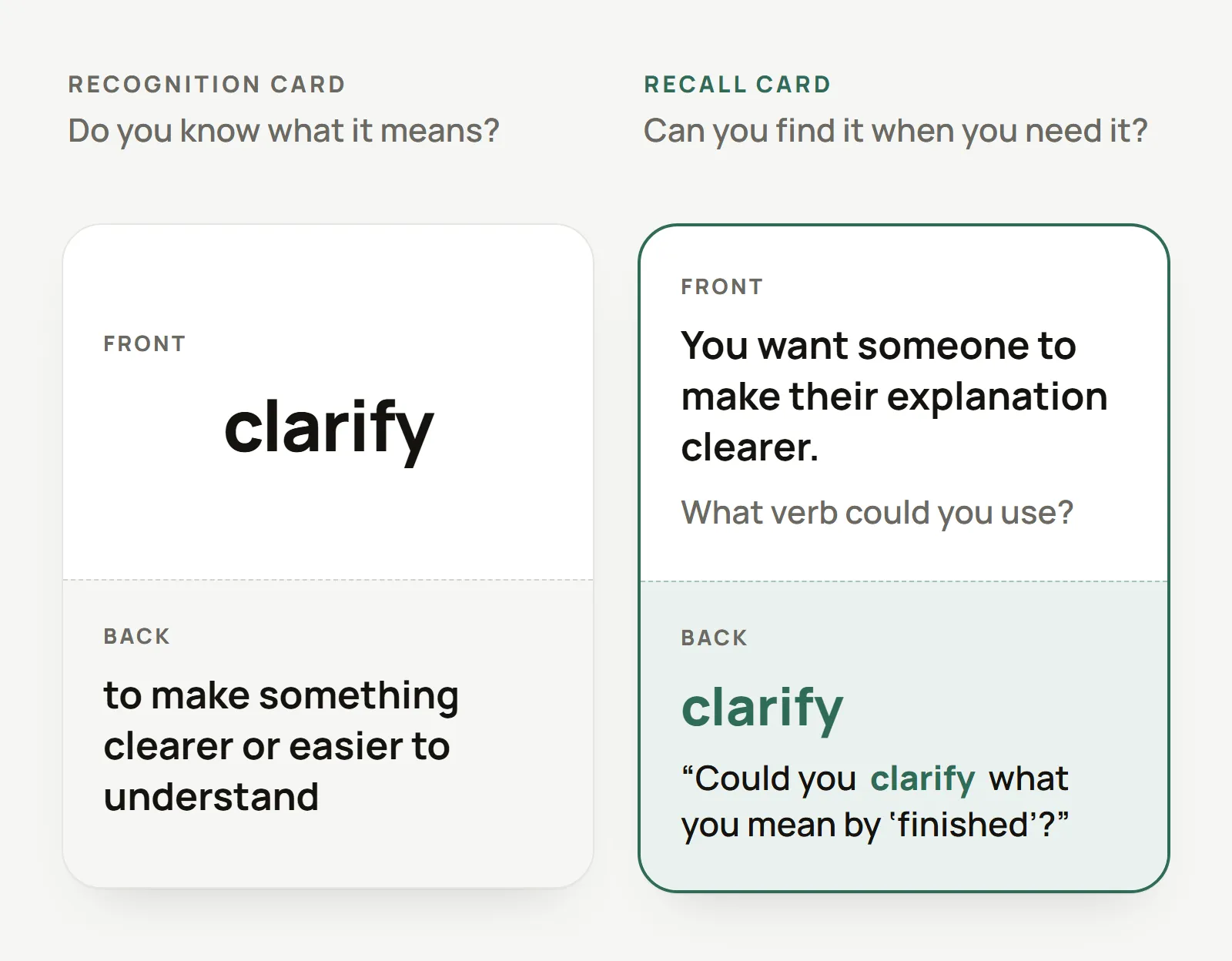
You want to ask someone to make their explanation clearer. What verb could you use?
Try to retrieve clarify before checking. Then use it:
- Could you clarify what you mean by “finished”?
If you cannot remember the word, look at the answer, check how it is used, and try again later. Spending a long time stuck is not the goal. The useful part is making an attempt before the answer appears.
This also changes how you use flashcards. A card that shows clarify and asks for its meaning tests something different from a card that asks you to produce clarify yourself.
Use the same word in different sentences
One example sentence is a starting point. It should not become the only sentence you can produce.
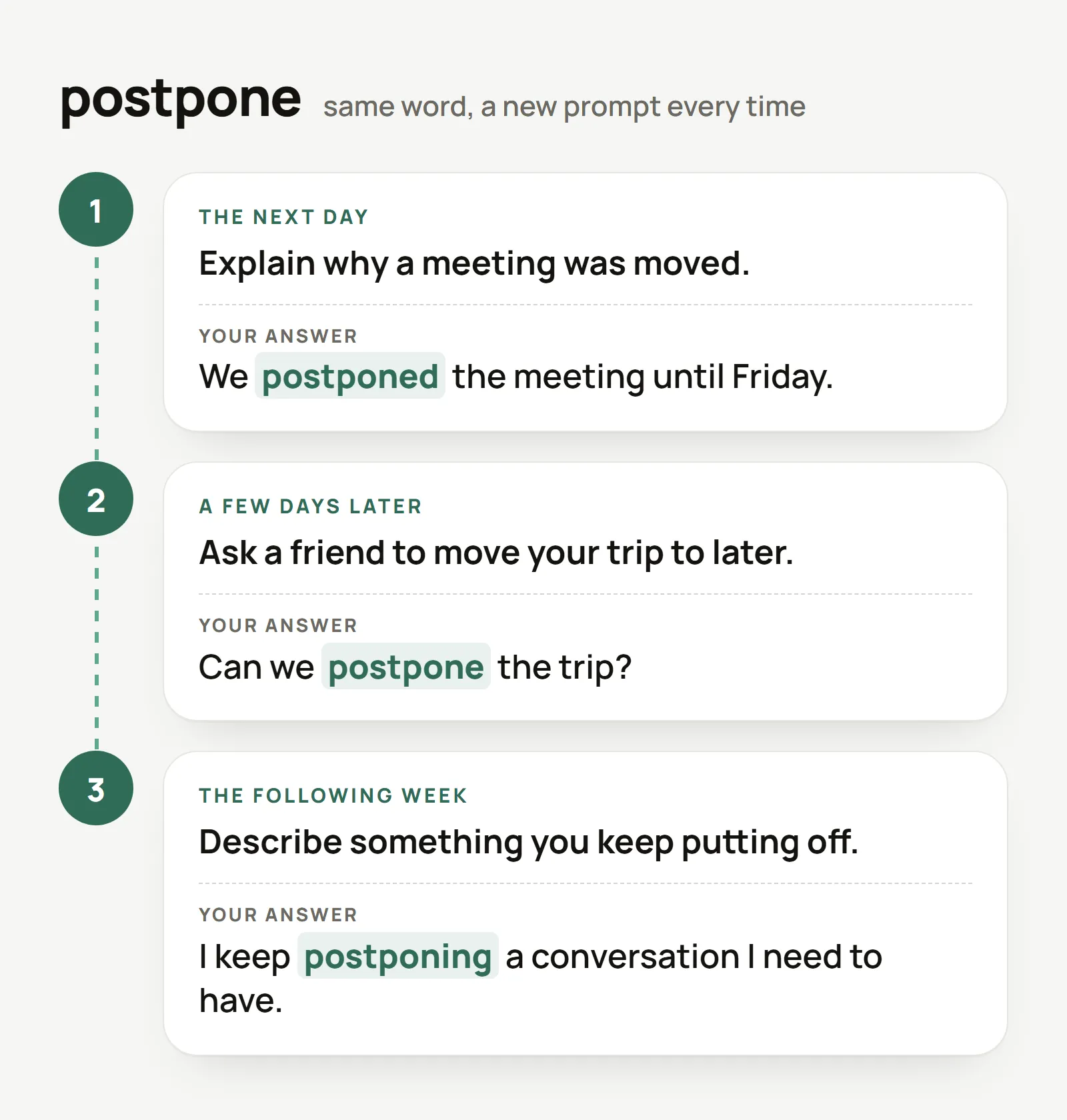
With postpone, you could practice:
- We postponed the meeting until Friday.
- Can we postpone the trip?
- I keep postponing a conversation I need to have.
The word stays the same, but the subject, tense, and situation change.
After studying an example, hide it and write a new sentence. Make it about your own life when possible. That gives you a reason to choose the word rather than simply copy it.
If you use AI to generate examples, attempt your own answer before asking to see a model response. Check unfamiliar usage against a reliable learner’s dictionary; generated examples can contain mistakes.
Learn the phrase around the word
Knowing a translation does not always tell you how to build a sentence.
Learn useful patterns alongside the word:
| Word | Useful pattern | Example |
|---|---|---|
| reluctant | reluctant to do something | I was reluctant to complain. |
| depend | depend on something | It depends on the weather. |
| aware | aware of something | I wasn’t aware of the change. |
| suggest | suggest doing something | She suggested leaving earlier. |
These patterns give you part of the sentence structure you need when retrieving the word.
Practice a new example with the same pattern, then check both the vocabulary and the grammar around it.
Revisit the word with a fresh prompt
Writing three sentences today does not mean a word will be easy to retrieve next week.
Return to it across several sessions. A simple starting schedule is the next day, a few days later, and the following week. Adjust it according to how easily you remember. A spaced repetition scheduler can do this adjusting for you: here is how FSRS picks the day a word comes back.
Change the prompt when you return:
- First review: explain why a meeting was postponed.
- Next review: ask to postpone a trip.
- Later review: describe something you keep postponing.
You are checking whether you can retrieve the word in another situation, rather than whether you remember yesterday’s sentence.
Add spoken practice if speaking is your goal
Writing gives you time to think. Conversation gives you less.
After writing a sentence, hide it and say the idea aloud. Then change one detail and say it again.
For example:
- I was reluctant to ask for help.
- My colleague was reluctant to change the plan.
Eventually, use the word when it fits a real conversation. Do not force advanced vocabulary into every sentence. The aim is to have more choices available, including simple words when they work best.
A 10-minute routine for activating vocabulary
Try this with five words you already understand:
- Two minutes: recall each word from a meaning or situation before checking the answer.
- Four minutes: write one new sentence per word. Check the word choice and sentence pattern.
- Two minutes: hide your answers and express two or three of the ideas aloud.
- Two minutes: note which words were difficult and schedule another review.
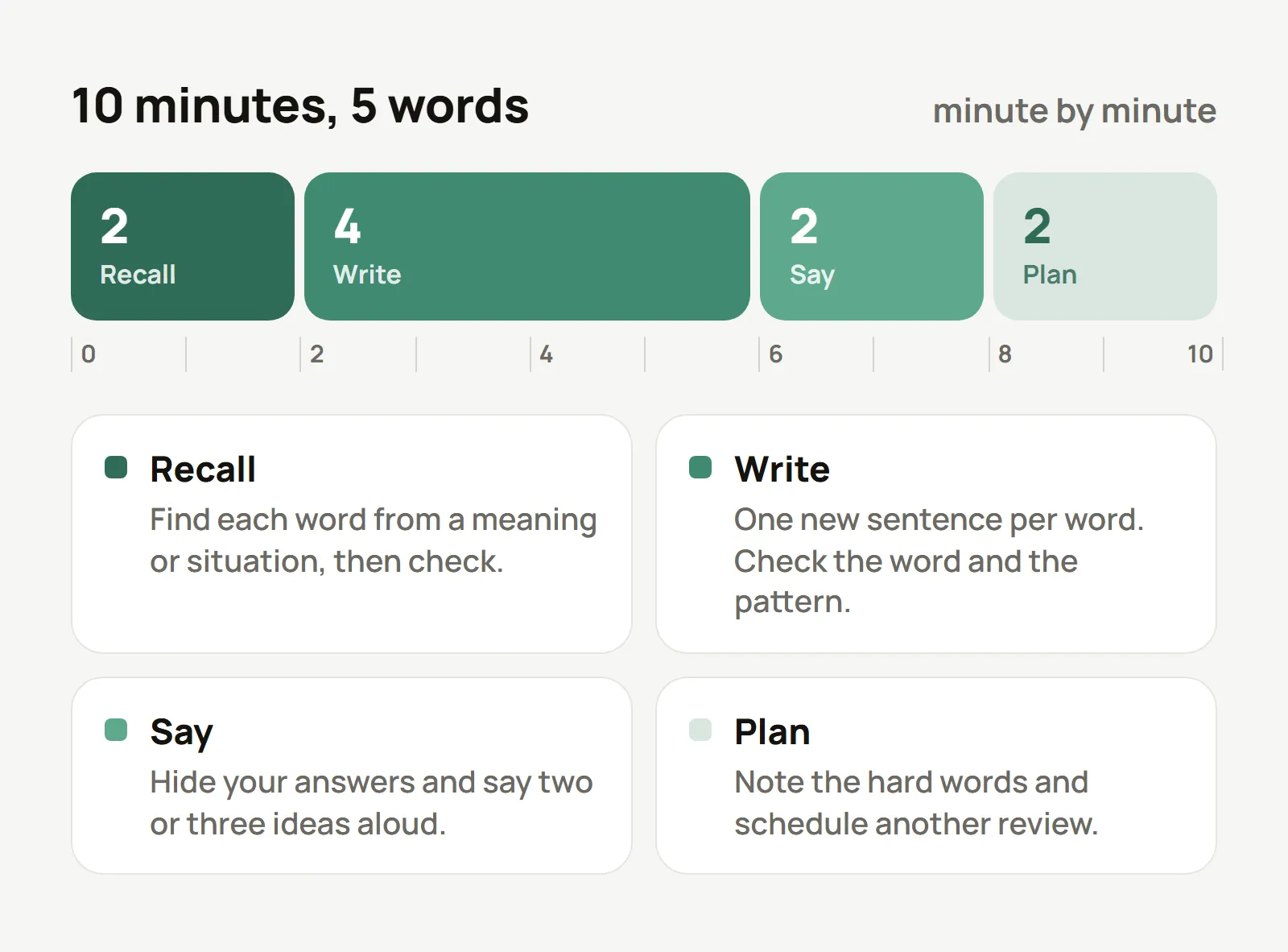
Ten minutes is a practical time limit, not a promise of results. Reduce the number of words if you need more time to check your answers.
To track progress, return to an older word with a fresh prompt. Can you retrieve it without seeing the answer? Can you use it in a different sentence? Can you say it aloud without reading?
Those checks tell you more about active use than recognizing a familiar card does.
Practice with new contexts in FlashLoop
Preparing fresh sentences for every review takes time. It is also easy to keep repeating the examples you already know.
FlashLoop is built around the same steps. You save a word with the sentence where you found it. When the word is due, FlashLoop shows you a new sentence in your own language, written by AI around that word, and you type or say it in the language you are learning before the answer appears. AI feedback then points out what to fix in grammar, word choice and phrasing, and FSRS decides when the word comes back, in a different sentence next time.
Use the same approach from this article: attempt the answer before checking, pay attention to the sentence pattern, and then try expressing a similar idea about your own life.
Start with five words you understand but struggle to use. Practice recalling them in new sentences, then bring them into your own writing and conversations.