You understand an English sentence. You know the words. But when you try to say it, the rhythm feels awkward and every word comes out separately.
Shadowing gives you a way to practice that gap between understanding speech and producing it. You listen to a recording and speak along with it, following the speaker’s pronunciation, stress, and intonation.
It is a focused speaking exercise you can do alone. The challenge is using it deliberately, rather than simply repeating sounds.
What is shadowing in language learning?
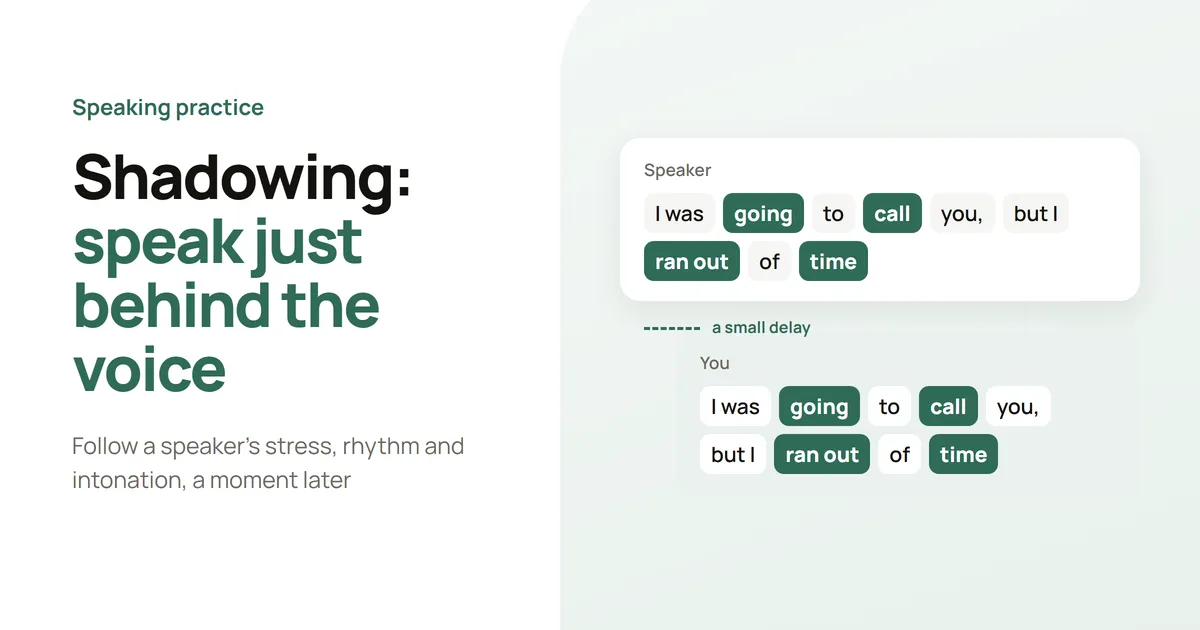
In shadowing, you repeat what a speaker says almost immediately, with a small delay, while the recording continues. You follow the voice like a shadow.
Suppose you hear:
“I was going to call you, but I ran out of time.”
You begin speaking just behind the speaker, trying to follow how the sentence sounds as a whole.
There is a useful distinction between two exercises:
- Listen and repeat: listen to a sentence, pause the recording, and say it back.
- Shadowing: repeat just behind the speaker without stopping the recording.
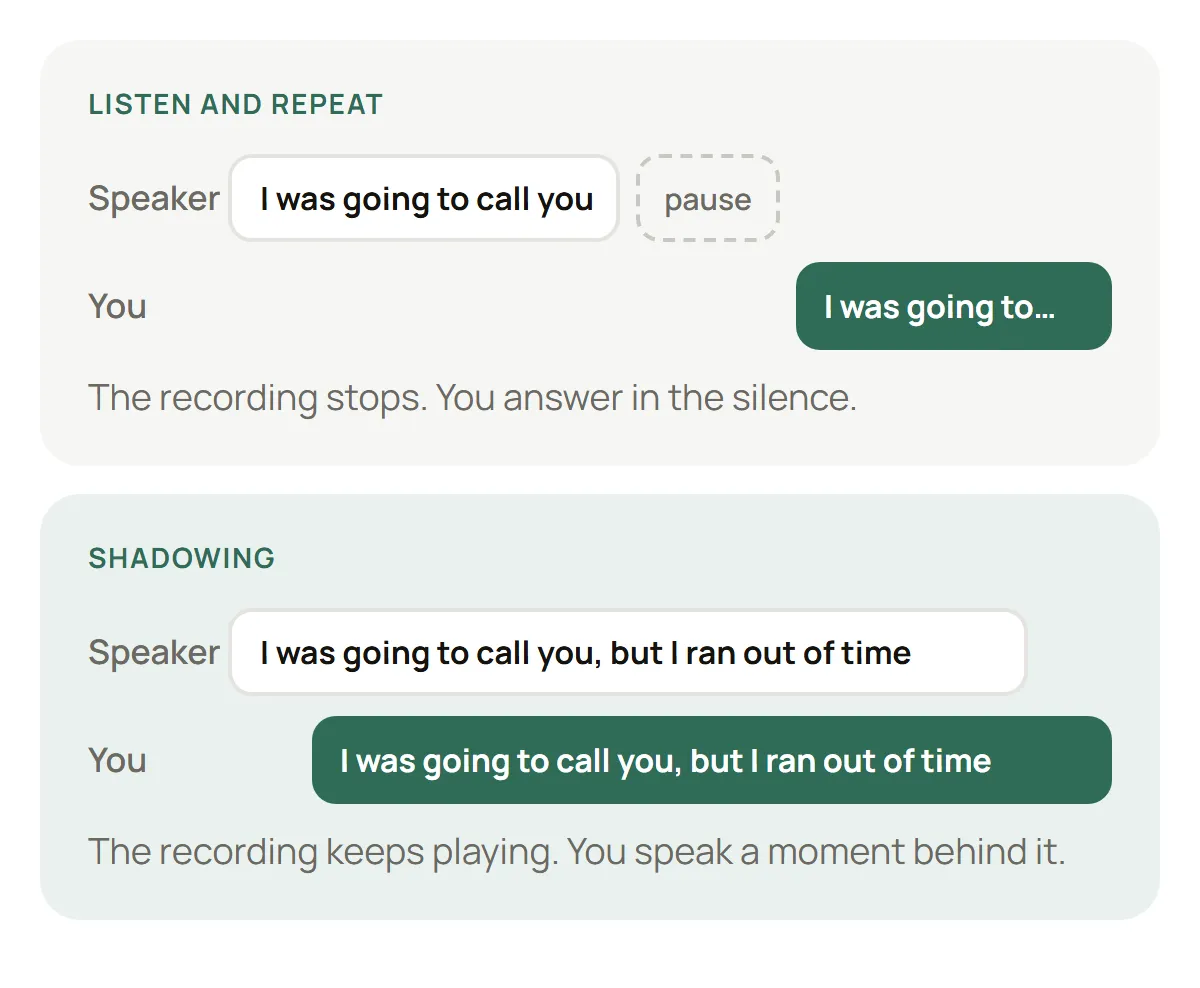
Listen-and-repeat practice can prepare you for shadowing. You do not need to start with the harder version.
What can shadowing help you practice?
Sentence stress and rhythm
English speakers do not give every word equal emphasis. Some words carry the message; others are shorter and less prominent.
In “I THOUGHT you were coming on FRIDAY,” the emphasis helps communicate meaning. Moving the stress can change what the speaker is correcting or questioning.
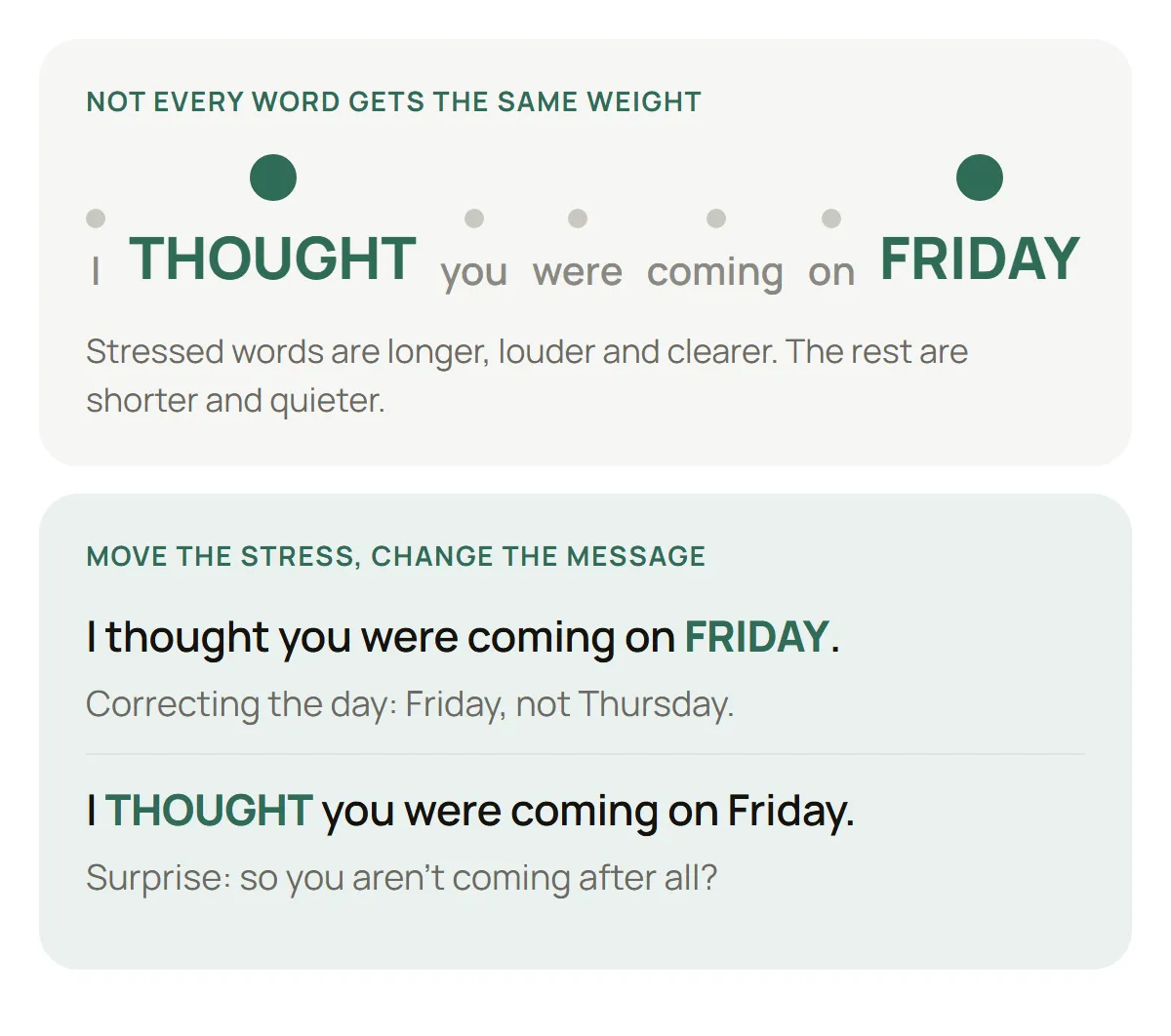
Shadowing gives you an audible model to follow instead of relying only on the written sentence.
Intonation and connected speech
A sentence can sound uncertain, surprised, friendly, or irritated depending on the voice.
Words also change when spoken together. A phrase that looks familiar on the page may be difficult to recognize in a conversation because its sounds are linked or reduced.
Following a recording lets you pay attention to those details. Focus on one feature at a time: perhaps the rising pitch of a question or the way two words connect.
Saying familiar phrases aloud
Knowing an expression and being comfortable saying it are different things.
Shadowing provides guided practice producing phrases such as “That depends on…” or “What I’m trying to say is…”.
However, repeating a phrase with a recording does not establish that you can retrieve it independently. That needs a separate exercise. (More on that in how to turn passive vocabulary into active vocabulary.)
How to practice shadowing: a step-by-step routine
The following routine is a practical starting point. Its timing is a suggestion, not a required training formula.
1. Choose a short recording
Start with roughly 20–40 seconds of clear speech from one speaker. Pick a topic you understand and a voice you can hear easily.
A short explanation, interview answer, or personal story can work. For your first sessions, avoid overlapping speakers, loud background music, and scenes that depend heavily on visual context.
A transcript or accurate subtitles will make preparation easier.
2. Understand the message
Listen once without speaking. Then check the transcript and clarify unfamiliar expressions.
For this routine, choose material whose meaning becomes clear after that preparation. If every sentence needs extensive translation, use an easier clip so you can concentrate on sound.
3. Repeat short sections after pausing
Play one phrase, pause, and repeat it.
Listen for a specific detail:
- Which word receives the strongest emphasis?
- Where does the speaker pause?
- Does the pitch rise or fall?
- Which words sound shorter than you expected?
Work on that detail before adding another.
4. Shadow the recording
Play the clip again and speak just behind the voice.
Use the transcript initially if needed. If you repeatedly lose your place, shorten the section or reduce playback speed temporarily. Return to normal speed as the passage becomes manageable.
The aim is controlled imitation. Rushing through missing words makes it harder to hear what needs work.
5. Record a short attempt
Record yourself, then compare a few seconds with the original. A solo recording of the same passage can also help you hear your voice without the model covering it.
Identify one difference you can describe: a missing final sound, misplaced stress, or a pause in an awkward place.
Repeat with that specific target.
6. Speak without the model
Stop the audio and put away the transcript.
Summarize the message or adapt one expression to your own experience. This changes the task: you now have to choose words and build a message yourself.
If the recording says:
“I was going to call you, but I ran out of time.”
Your own examples might be:
“I was going to finish the report, but another task took longer than expected.”
“I was going to cook dinner, but we decided to go out.”
This step checks whether you can use the pattern beyond the original clip.
A simple 10-minute shadowing session
| Time | Activity |
|---|---|
| 2 minutes | Listen, read the transcript, and check meaning |
| 2 minutes | Repeat short phrases after pausing |
| 3 minutes | Shadow the passage |
| 2 minutes | Record, compare, and adjust one feature |
| 1 minute | Make your own sentences without the audio |
Adjust the balance to your difficulty. If one line remains unclear, spend the session on that line.
Common shadowing mistakes
Choosing material that is too difficult. You spend the session trying to keep up, with little attention left for pronunciation.
Reading louder than you listen. The transcript becomes a reading exercise. Keep checking your voice against the recording.
Trying to fix everything at once. Select one target per attempt so you can judge whether it changed.
Repeating without checking. A recording gives you evidence to compare. Familiarity alone can make an attempt feel better.
Treating imitation as conversation. Real communication also requires choosing your message, retrieving vocabulary, and responding to another person.
What shadowing cannot do on its own
Shadowing gives you the words and their order. It does not require the same independent decisions as answering an unexpected question.
You may reproduce a passage smoothly while still struggling to explain your own opinion. That means your next task should include independent speaking, writing, or conversation. If that sounds familiar, read You know the word. So why can’t you use it?
Shadowing also does not provide automatic correction. If you cannot identify a pronunciation difference, feedback from a teacher can be useful.
Judge progress through specific observations, such as following a passage with fewer interruptions or reproducing its stress more closely. A fixed number of sessions cannot guarantee fluency or a particular accent.
YouTube channels and teachers who explain or demonstrate shadowing
Watching someone demonstrate the technique is the fastest way to understand the timing. These teachers approach it from different angles, so pick the one closest to what you need.
| Teacher (channel) | Accent | Best for |
|---|---|---|
| Lucy Earl (English with Lucy) | British | A first guided lesson |
| Hadar Shemesh (Accent’s Way English with Hadar) | American | Choosing what to imitate |
| Emma Saloranta (mmmEnglish) | Australian | From imitation to shadowing |
| Claire (English Teacher Claire) | American | A ready-made session |
| Vanessa (Speak English With Vanessa) | American | A listen-and-repeat warm-up |
| Alexander Arguelles | — | Where the method comes from |
English with Lucy (Lucy Earl)
English Speaking Practice – Speak with me! (Shadowing Method)
Lucy introduces shadowing and leads a guided speaking lesson. A useful starting point for learners who want an explanation followed by practice with a British English model.
Channel: English with Lucy on YouTube.
Accent’s Way English with Hadar (Hadar Shemesh)
Shadowing Technique in English: are you wasting your time?
Hadar discusses how to practice, common mistakes, and the importance of choosing a specific feature to imitate. Useful if you already repeat recordings but lack a clear practice target.
Her companion article also outlines the approach. Channel: Accent’s Way English with Hadar on YouTube.
mmmEnglish (Emma Saloranta)
Lesson 1 – Speak English Clearly! The Imitation Technique
Emma demonstrates a progression from listening with text to repeating during pauses and then speaking along without the text. Useful for understanding how preparatory imitation leads into shadowing.
Channel: mmmEnglish on YouTube.
English Teacher Claire
Repeat-After-Me + Shadowing Practice!
A practice session that combines both exercises from this article: repeating during pauses, then speaking along with the voice. Useful when you want to follow a ready-made session instead of preparing your own clip.
Channel: English Teacher Claire on YouTube.
Speak English With Vanessa
Listen and Repeat: SPEAK with me in English
A guided listen-and-repeat lesson with an American English model. It is the preparatory step from this article’s routine, so it works well as a warm-up before you shadow a recording of your own.
Channel: Speak English With Vanessa on YouTube.
Alexander Arguelles
Alexander Arguelles, a linguist and polyglot, is widely credited with popularizing shadowing among self-taught language learners. In this long talk he discusses and comments on his own version of the technique, which he applies to many languages, not only English. His channel has more on the subject, including “On the Evolution of Shadowing” and “6 Questions Answered About Shadowing”.
Channel: Alexander Arguelles on YouTube.
Save new words you discover while shadowing
When you come across an unfamiliar word or expression, check its meaning and save it in your vocabulary list or as a flashcard. Include the sentence where you found it so you remember how it was used. You can do this after finishing the clip to avoid interrupting every attempt.
For example, if a speaker says “We had to put off the meeting,” save put off with the meaning postpone and the original sentence.
FlashLoop helps you turn those discoveries into regular vocabulary practice. Add the words and expressions you want to remember, then review them with spaced repetition. FlashLoop generates new sentences for each review, so you practice the same vocabulary in different contexts instead of memorizing a single example. It also analyzes mistakes in your written answers to help you identify recurring difficulties.
Shadowing gives you the first encounter with a phrase in spoken English. Saving and reviewing it gives you more opportunities to remember it and use it yourself.
Frequently asked questions
Can beginners use shadowing?
Yes, with very short, understandable material. Start by listening and repeating after pauses, then try following the recording continuously.
Should I use subtitles?
Use an accurate transcript to prepare and check meaning. Then try a short section without it to see whether you are following the voice or relying on reading.
Should I copy a British or American accent?
Choose a clear model suited to your goals. For focused practice, using a consistent speaker makes comparisons easier. You can still listen to a wider range of accents elsewhere.
Is shadowing enough to become fluent?
No single imitation exercise covers all the demands of communication. Pair it with tasks where you choose what to say and respond without a script.